Latest

Showing posts with label Political News. Show all posts

Monday, 30 October 2017

Catalonia independence: Spain to take control of Catalan institutions

Spain is set to put in place measures to take direct control of Catalonia in response to the region's declaration of independence last week.
On Friday, Madrid stripped Catalonia of its autonomy and removed Catalan leader Carles Puigdemont from office.
The temporary move will see as many as 150 of the region's ministers replaced. Some have vowed to continue to work.
Mr Puigdemont and other Catalan officials may face criminal charges, a move likely to lead to huge protests.

What happens next?

Spain's central government is set to take control of Catalan institutions with Spanish officials expected to be put in place in the region's ministries on Monday.
Madrid has called for the Spanish constitutional court to revoke Catalonia's unilateral vote for independence.
Mr Puigdemont and his vice-president Oriol Junqueras say they do not accept the moves by Madrid, adding that they can only be removed from office by the citizens of Catalonia.
If Mr Puigdemont and others refuse to step aside, they face possible arrest and prosecution on charges of rebellion - the maximum sentence for which is 30 years.
About 200,000 civil servants are due to arrive on Monday, but it is not clear how many will stay away or refuse to follow instructions.
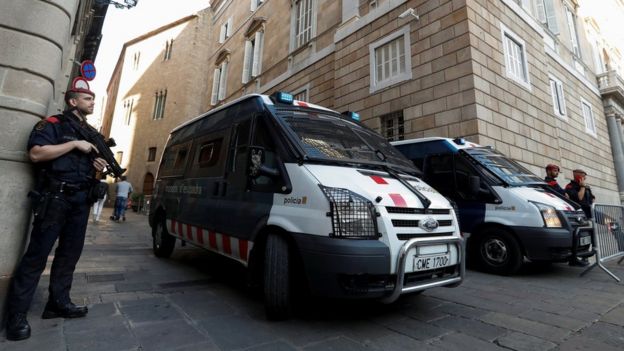
Mossos, Catalan regional police, guard guard the Catalan regional government headquarters in Barcelona, 30 October 2017Image copyrightREUTERS
Image captionCatalan regional police (Mossos) guard the Catalan regional government headquarters
Catalonia's regional police force, known as Mossos, whose chief was dismissed last week, are deployed in Sant Jaume square, near the government palace in the centre of Barcelona.
Spain's Foreign Minister Alfonso Dastis has said he expects the officers to "act professionally".
Spain's chief prosecutor has also been preparing criminal charges against any officials considered to have acted against Spanish law in declaring independence following a referendum deemed illegal under the Spanish constitution.
Meanwhile, Madrid has called for fresh regional elections on 21 December.
Mr Puigdemont could run in new elections, according to Mr Dastis, but only if the sacked Catalan leader has not been jailed.

What about Catalonia's autonomy?

On Sunday, Mr Dastis told Sky News: "We are not taking autonomy away from Catalonia. We are just re-establishing it, in fact."
He added: "Reality is already sinking in, will continue sinking in and they will realise that they cannot do something without the authority of law and they will be usurping authority."
Meanwhile, Interior Minister Juan Ignacio Zoido has written to all police officers in Catalonia asking for their loyalty as a "new era" begins in the region.
He reminded members of the regional police, who are now under direct control from Madrid, of their duty to obey orders and to guarantee "the rights and liberties of all".
Senior police officers have told the BBC that they have already complied with an order to remove framed photographs of Mr Puigdemont from police stations across the region.
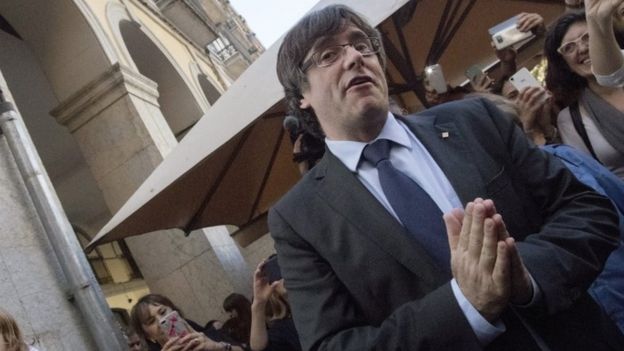
Sacked Catalan leader Carles Puigdemont greets supporters at the entrance of a restaurant in Girona, 28 October 2017Image copyrightEPA
Image captionMr Puigdemont has urged "democratic opposition" to direct rule from Madrid

What is the local press saying?

  • The centre-left and unionist Madrid-based El País says that Sunday's huge pro-union protest in Barcelona "has shown in this difficult moment that Catalan society is much more plural than what the pro-independence block strives to show"
  • The pro-union Barcelona-based El Periódico says the protest was the "start of the election campaign". It adds that "the new regional elections should serve to move Catalonia out of its current impasse"
  • The pro-independence Catalan language Ara suggests in an editorial that it would be an "error" for the pro-independence parties not to contest the 21 December elections
  • The moderate Barcelona-based La Vanguardia focuses on the importance of "reconstruction" and how to overcome the divisions in Catalan society. "All sides will inevitably discover that there is no political problem that cannot be resolved by dialogue" it says

Rule from Madrid

Spain has been gripped by a constitutional crisis since a referendum, organised by Mr Puigdemont's separatist government, was held earlier this month in defiance of a ruling by the constitutional court which had declared it illegal.
The Catalan government said that of the 43% of potential voters who took part, 90% were in favour of independence.
Friday saw the regional parliament declare independence.
Spanish Prime Minister Mariano Rajoy then announced the dissolution of the regional parliament and the removal of Mr Puigdemont as Catalan leader.
Mr Puigdemont has urged "democratic opposition" to direct rule from Madrid.

Media captionFlags in Catalonia and what they mean
Before Madrid took over the Catalan government, the region had one of the greatest levels of self-government in Spain.
It has its own parliament, police force and public broadcaster, as well as a government and president, though those have now been dismissed.
Catalans had a range of powers in many policy areas from culture and environment to communications, transportation, commerce and public safety.

Wednesday, 25 October 2017

Elton John Slams Lawmaker's 'Horrific' Comment on HIV 'Quarantine'

Betty Price, a Republican state representative in Georgia and a physician who is married to former Health and Human Services Secretary Tom Price, came under fire last week after using the term “quarantine” when asked about ways to curtail the spread of HIV. Now Elton John — the rock Hall of Famer, LGBTQ advocate and founder of the Elton John AIDS Foundation — is adding his voice to the chorus of those criticizing Price.
"Rep. Betty Price's comments about people living with HIV are horrific, discriminatory, and astonishingly ill-informed," John said in a statement emailed to NBC News. "As a doctor and elected official from a state where people are still contracting HIV at an alarming rate, Mrs. Price should know better than to demonize people and perpetuate myths that stigmatize people living with HIV.”
During a Georgia House of Representatives committee meeting on health care access last week, Price asked a question about what officials are “legally able to do” to limit the spread of HIV throughout the state.
“I don’t want to say the quarantine word, but I guess I just said it,” Price said to Dr. Pascale Wortley, director of the Georgia Department of Public Health’s HIV epidemiology section, during the Oct. 17 meeting, which was recorded on video. “Are there any methods legally that we could do that would curtail the spread?”
In his statement, John said Price’s words “smack of a dark time when there was little or no information about HIV and people were afraid of each other.”
“Instead of perpetuating fear and bias, Mrs. Price should educate herself about HIV and use her position of power to provide support, resources and compassion to her constituents. Love is the cure. Not quarantines,” John added.
Following criticism from health advocates and LGBTQ activists, Price shared a statement with The Atlanta Journal-Constitution on Saturday, saying her comments were "taken completely out of context.”
“I made a provocative and rhetorical comment as part of a free-flowing conversation which has been taken completely out of context," Price said. "I do not support a quarantine in this public health challenge and dilemma of undertreated HIV patients."
Georgia had the second-highest rate of new HIV diagnoses in the nation in 2015, according to the Centers for Disease Control and Prevention. From 2012 to 2014, the state's age-adjusted HIV death rates were almost twice as high as the national average.

Republican committees investigate Clinton and Obama

Republican committees investigate Clinton and Obama

Congressional Republicans have announced parallel inquiries into a uranium deal under President Barack Obama and Hillary Clinton's emails.
One committee will investigate how the Obama administration approved a 2010 acquisition that gave Russia control of 20% of the US uranium supply.
Two other panels will scrutinise the FBI decision not to charge Mrs Clinton over her private email server.
Democrats pilloried the inquiries as "a massive diversion".
Both issues to be placed under the spotlight by the committees are longstanding political grievances of President Donald Trump.
His campaign aides are currently the subject of congressional investigations into whether they colluded with alleged Kremlin attempts to sway last year's US presidential election.
On Tuesday, House Judiciary Committee Chairman Bob Goodlatte and House Oversight Committee Chairman Trey Gowdy announced inquiries into the previous administration.
They said there were "outstanding questions" about the FBI's investigation into former Democratic presidential candidate Mrs Clinton's emails.
The congressmen said they wished to know why former FBI director James Comey chose to divulge the inquiry into Mrs Clinton, but not the one about Trump aides and Russia.
Also on Tuesday, Devin Nunes, the Republican chairman of the House Intelligence Committee, announced his panel's inquiry into the sale of a Canadian mining firm that had mines in the American West.
Uranium One - which owned a fifth of US uranium supplies - was acquired seven years ago by Russian state-owned company Rosatom.
The US Department of State, under former Secretary of State Mrs Clinton, helped approve the deal.
The Hill reported last week that at the time of the sale the FBI was investigating alleged attempts by Moscow to gain influence in the US nuclear industry through bribery and extortion.
The Hill and New York Times have reported that Russian nuclear officials and Uranium One's chairman donated millions of dollars to the Clinton charitable foundation.
Mr Nunes told reporters at Capitol Hill on Tuesday: "One of the things we are concerned about is whether or not there was an FBI investigation, was there a DOJ [Department of Justice] investigation and if so, why was Congress not informed of this matter."
President Trump has sought to draw attention to the story, tweeting last week: "Uranium deal to Russia, with Clinton help and Obama Administration knowledge, is the biggest story that Fake Media doesn't want to follow!"
But Democratic congressmen accused Republicans on Tuesday of creating a distraction.
"This new investigation is a massive diversion to distract from the lack of Republican oversight of the Trump administration and the national security threat that Russia poses," said Elijah Cummings and John Conyers in a statement.
Mrs Clinton said in an interview with cable network C-SPAN on Monday that the Uranium One allegations are "baloney".

Monday, 23 October 2017

Myeshia Johnson: Soldier's widow says Trump made me cry


Media captionHow one phone call has sparked uproar
The widow of a dead US soldier says Donald Trump could not remember her husband's name when he phoned to offer condolences.
Myeshia Johnson, widow of Sgt La David Johnson, told ABC News the president's "stumbling" and tone "made me cry".
But President Trump said that he had used Sgt Johnson's name "without hesitation" and described the conversation as "very respectful".
Sgt Johnson was killed in Niger by Islamist militants this month.
President Trump's call of condolence made headlines when Democratic congresswoman Frederica Wilson - who had heard it along with the family - accused him of insensitivity.
Myeshia Johnson appeared to confirm Ms Wilson's assertion that Mr Trump had told her her husband had known what he had signed up for when joining the military.
"The president said that he knew what he signed up for, but it hurts anyways... It made me cry because I was very angry at the tone of his voice and how he said it," she said.
"He had my husband's report in front of him, and that's when he actually said La David. I heard him stumbling on trying to remember my husband's name."
"If my husband is out here fighting for our country and he risks his life for our country, why can't you remember his name?" she added.
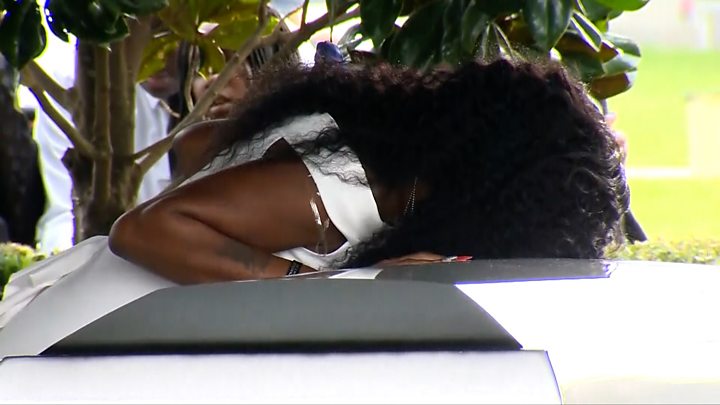
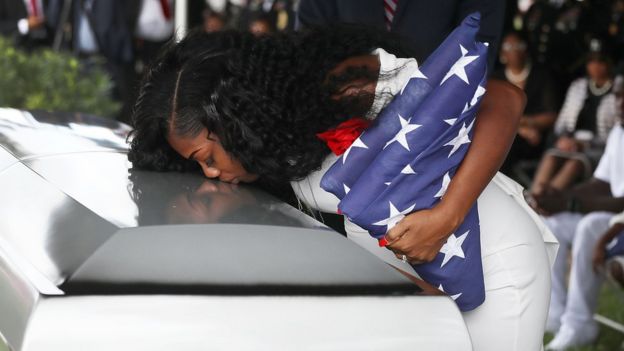
Myeshia Johnson weeping on her husband's coffin at his funeral in Hollywood, Florida on 21 OctoberImage copyrightGETTY IMAGES
Image captionMyeshia Johnson wept on her husband's coffin at his funeral in Hollywood, Florida
presentational line

No-win situation

By Anthony Zurcher, BBC News, Washington
The Donald Trump condolence-call story is a White House headache that shows no signs of abating.
It started badly for the president, as he responded to a question about US military casualties in Niger by questioning how his predecessors had dealt with the families of war dead.
It got worse, as the story morphed into one of an allegedly callous presidential call to Myeshia Johnson, a grieving widow of one of the US soldiers killed in Niger.
Now it's devolved into a he-said, she-said debate. Democratic Congresswoman Frederica Wilson - who knew the slain soldier - and Ms Johnson and her family claim the president mishandled the call, while Mr Trump and Chief-of-Staff John Kelly insist everything went smoothly.
Needless to say, arguing with a war widow is a no-win situation, regardless of who has facts on their side. President George W Bush notably withstood harsh criticism from some bereaved families during the Iraq War without swiping back.
This president is different, which should come as a surprise to no one at this point. His choices could come at a high political price, however.
presentational line

How did Trump respond?

President Trump defended himself on Twitter on Monday, writing: "I had a very respectful conversation with the widow of Sgt La David Johnson, and spoke his name from beginning, without hesitation!"
He has dismissed the account of the phone call given by Ms Wilson as "totally fabricated".
Speaking to reporters, he said: "I did not say what she [Ms Wilson] said... I had a very nice conversation."
The White House said Mr Trump's conversations with the families of dead servicemen were private.
presentational line

How did this row begin?

Sgt Johnson was one of four US special forces soldiers who died in an ambush in Niger on 4 October. Mr Trump was criticised for not contacting the families of the dead servicemen right after they were killed, or publicly commenting on their deaths until 12 days later when asked by a reporter.
He responded to this criticism by falsely claiming that his predecessor, Barack Obama, and other former US presidents had not called the relatives of dead service members.
Media captionTrump denigrates Obama over false fallen soldier claim
The row escalated when Mr Trump pointed out that his chief of staff, General John Kelly, after his son was killed in Afghanistan, did not receive a call from President Obama.
The White House later said Mr Trump had spoken to the families of those killed in Niger but did not say when.
presentational line

What happened in Niger?

On 4 October, it was reported that three US soldiers had been killed and two others wounded in an ambush near the West African nation's border with Mali.
The injured soldiers were evacuated to the Landstuhul Regional Medical Centre in Germany and were said to be in a stable condition.
Two days later, the body of Sgt Johnson was found, making him the fourth American to die in the attack.
But the details of how the ambush happened - and how Sgt Johnson's body went missing - are still unclear.
The US Africa Command said the soldiers had been providing assistance to Niger's "security force counter terrorism operations", and the US defence department said they had died as a result of "hostile fire while on a reconnaissance patrol".
Officials say the attack was probably carried out by an affiliate of so-called Islamic State. Some reports suggest up to 50 militants may have ambushed the group.
Islamist militants, including al-Qaeda fighters, are known to operate in the region.
presentational line

What are US troops doing in Niger?

The deployment seemed to be news to some US congressmen.
At least three senators said on Monday they were unaware that there are reportedly 1,000 American soldiers in the African nation.
Republican Senator Lindsey Graham, who sits on the armed services committee, admitted he had "little insight on why they [the US troops] were there and what they were doing".
General Joseph Dunford, Chairman of the Joint Chiefs of Staff, said on Monday that the US has had forces in Niger on and off for 20 years.
American servicemen have most recently been on active duty in the country since 2013.
In a letter to Congress in June, President Trump confirmed there were 645 military personnel deployed there to support counter-terrorism missions.